September 14th Research Briefing
A weekly publication of the top three papers from arXiv last week. Papers with arXiv v1 published 2026-09-07 through 2026-09-13 UTC.
Contents
- IntentFuzz: protocol-aware fuzzing finds live bridge invariant breaks
- A2ABreak: eleven A2A protocol flaws under full compliance
- EventSpec: event-semantic defects reach wallets and bridges
IntentFuzz: protocol-aware fuzzing finds live bridge invariant breaks
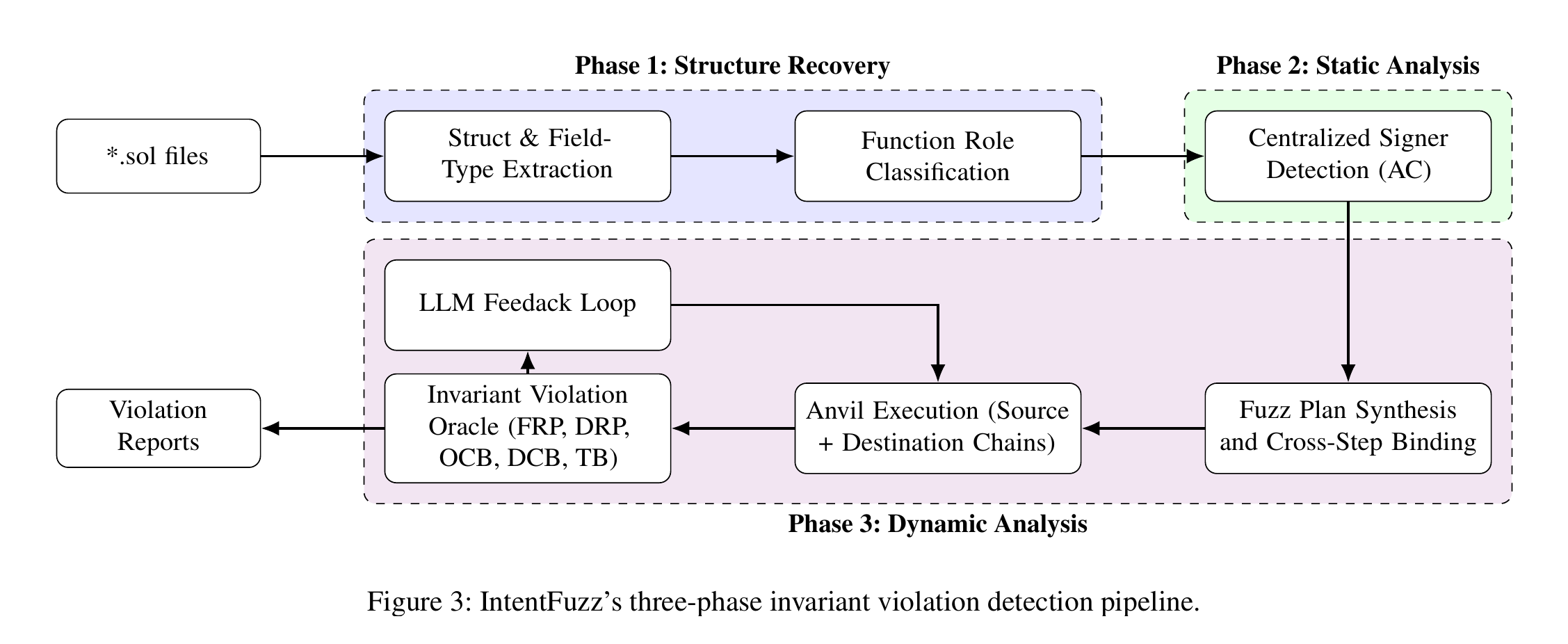
IntentFuzz recovers intent structure and deposit/fill roles from unannotated Solidity, then synthesizes multi-step fuzz sequences to check local safety invariants on intent-based cross-chain bridges. On 24 real-world deployments it confirms 22 genuine invariant violations (17 with heuristics alone) across eight GitHub repositories, each reproduced against public bytecode.
This matters because solver-driven bridges lock funds on one chain while settlement is off-chain. Generic fuzzers chase coverage inside a single call and never bind a later fill to an earlier deposit.
The pipeline classifies the intent struct and deposit/fill functions, flags fills gated on a single stored authority, then runs replay, chain-binding, and deadline templates on forked Anvil state. An LLM is used only when heuristic arguments miss the guard. On 23 planted-bug mutants the oracle reports 100% recall and precision. The LLM tier raises step-0 deposit success from 54.4% to 85.0% and adds five deposit-replay findings.
Authors: André Augusto, Christof Ferreira Torres, André Vasconcelos, and Miguel Correia (paper, pdf). Christof Ferreira Torres: GitHub, X, LinkedIn. André Augusto: GitHub.
A2ABreak: eleven A2A protocol flaws under full compliance
A2ABreak is a systematic security analysis of the Linux Foundation Agent2Agent (A2A) protocol. An LLM-assisted pipeline extracts a verified finite-state machine with 37 states and 76 transitions from 929 formalized statements, then adversarially verifies attack traces under full compliance. The analysis finds 11 new protocol-level vulnerabilities that a specification-compliant adversary can exploit with no implementation bug.
This matters because A2A is becoming the horizontal layer for multi-vendor agent delegation. SHOULD/MAY-level security guidance leaves gaps that implementation fuzzing cannot reach when no open reference stack exists.
The pipeline extracts statements from the live spec, builds per-stage FSMs, and keeps only traces that stay on valid states, remain executable under full compliance, and rely on a primitive the spec omits. Findings include cross-client context injection through unprotected context ids, credential harvesting via multi-hop identity loss, and exfiltration by rogue agents advertising unattested capabilities. Against expert review it reaches 73.3% precision and 84.6% F1. A zero-shot LLM baseline produced zero confirmed findings.
Authors: Alireza Lotfi, Mirza Masfiqur Rahman, Imtiaz Karim, and Elisa Bertino (paper, pdf). Imtiaz Karim: LinkedIn.
EventSpec: event-semantic defects reach wallets and bridges
EventSpec defines five event-semantic defect classes (event collision, state-event mismatch, unauthorized event emission, event emission mismatch, and event parameter mismatch), infers event specs from a contract corpus, and differentially checks targets. On 6,617 real-world contracts it reports 90.17% comprehensive precision. An off-chain harness reproduces event-origin confusion and event-state desynchronization against bridge relayers, explorers, and NFT marketplaces, and the authors report six wallet issues (four confirmed, including a $600 bounty).
This matters because the EVM records logs without enforcing that they match state. Bridges, wallets, and indexers that treat Transfer or Deposit events as authoritative can accept spoofed logs even when balances never moved.
The detector is bytecode-oriented: it extracts operand footprints and guard signals at log sites, builds corpus-derived profiles, and flags deviations with explainable evidence. The harness shows explorers accepting spoofed transfers with no balance delta and sleepminting-style patterns on major NFT marketplace testnets. Artifact: EventSpec.
Authors: Yixuan Liu, Yuxin Dong, Ye Liu, Yin Wu, Chengxuan Zhang, Xiapu Luo, and Yi Li (paper, pdf, EventSpec).